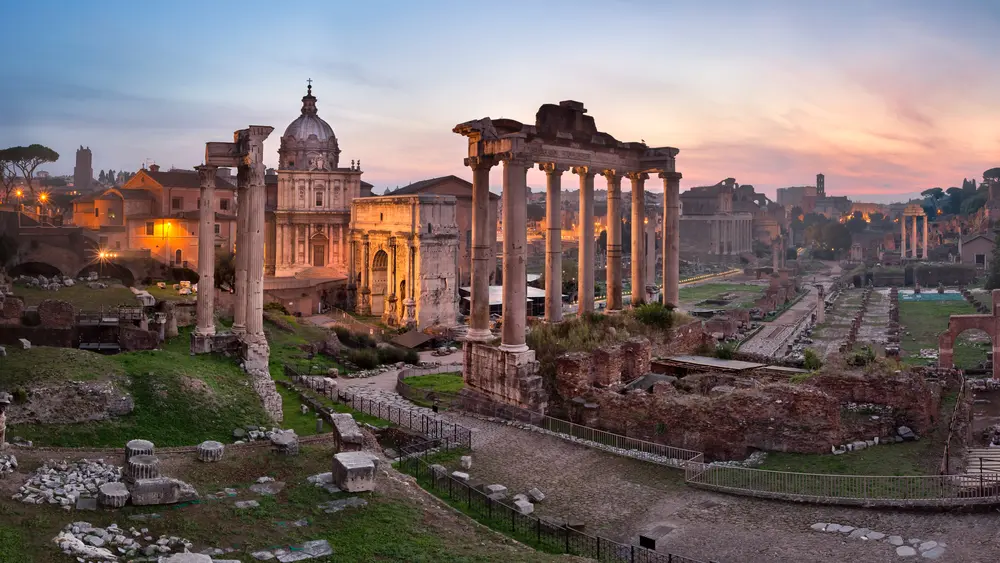
The Roman Forum stands today as one of the most extraordinary archaeological sites in the world, but in ancient times it was far more than a collection of ruins. It was the beating heart of Rome, a place where politics, religion, commerce, and daily life collided in a constantly shifting balance of power and ambition.
Walking through the Forum today, between broken columns and scattered stones, it is easy to forget that this very ground once shaped the destiny of an empire that stretched across continents. Yet every path, every fragment of marble, and every surviving arch tells a story of authority, influence, and human drama.
The Roman Forum as the center of ancient life
In ancient Rome, the Forum—known as the Roman Forum—was not a monument preserved behind glass. It was a living, breathing space. Merchants shouted prices, senators debated laws, priests conducted rituals, and citizens gathered to hear the latest decrees.
This was the place where public life unfolded in full view, where reputation mattered as much as power, and where visibility could define a political career. Unlike modern civic centers, the Forum had no single purpose. It was a multifunctional space that evolved organically over centuries.
Nearby stood the monumental Colosseum, reinforcing how tightly connected entertainment, politics, and public life were in ancient Rome. While the Colosseum hosted spectacles designed to impress and control the population, the Forum hosted the decisions that governed them.
Politics, speeches, and the architecture of power
One of the most striking aspects of the Roman Forum is how architecture was used as a political tool. Temples, basilicas, and arches were not simply religious or decorative structures—they were statements of authority.
The Senate House, known as the Curia, was where Rome’s most powerful men debated laws and foreign policy. Nearby, the Rostra platform served as the stage for public speeches, where orators could sway crowds with rhetoric that shaped public opinion.
In this environment, persuasion was everything. Political figures like Julius Caesar and Cicero mastered the art of public speaking, using the Forum as their stage. Every speech delivered here had the potential to influence military campaigns, elections, and even the fate of the Republic itself.
The Forum was, in essence, an ancient political arena where words carried the weight of swords.
Religion woven into daily and civic life
Religion in ancient Rome was inseparable from politics, and the Forum reflects this fusion clearly. Temples dedicated to gods such as Saturn, Vesta, and Castor and Pollux were central to the space, reminding citizens that divine favor was essential for the success of the state.
The Temple of Saturn, one of the oldest structures in the Forum, also functioned as the state treasury. This dual role—spiritual and economic—perfectly illustrates how Roman society saw no separation between sacred and civic life.
Priests performed rituals not in isolation, but in the middle of civic activity. This constant interaction between faith and governance reinforced the idea that Rome’s power was divinely sanctioned.
Even today, visitors often ask what the ruins of these temples actually represented. The answer lies in understanding that they were not just places of worship, but pillars of political legitimacy.
Commerce, crowds, and everyday chaos
Beyond politics and religion, the Roman Forum was also a bustling commercial hub. Shops, markets, and administrative buildings surrounded the central square, making it one of the busiest areas in the ancient city.
Citizens came here to trade goods, settle disputes, and gather news. Lawyers worked on legal cases in basilicas, while money changers and merchants operated in the open air. The atmosphere was often chaotic, filled with noise, movement, and negotiation.
Unlike modern curated historical sites, the Forum was never quiet or symbolic in its prime. It was practical, noisy, and constantly active.
This mix of functions is one of the reasons why the Forum remains so fascinating today. It was not designed with a single purpose, but rather grew into a complex ecosystem of Roman life.