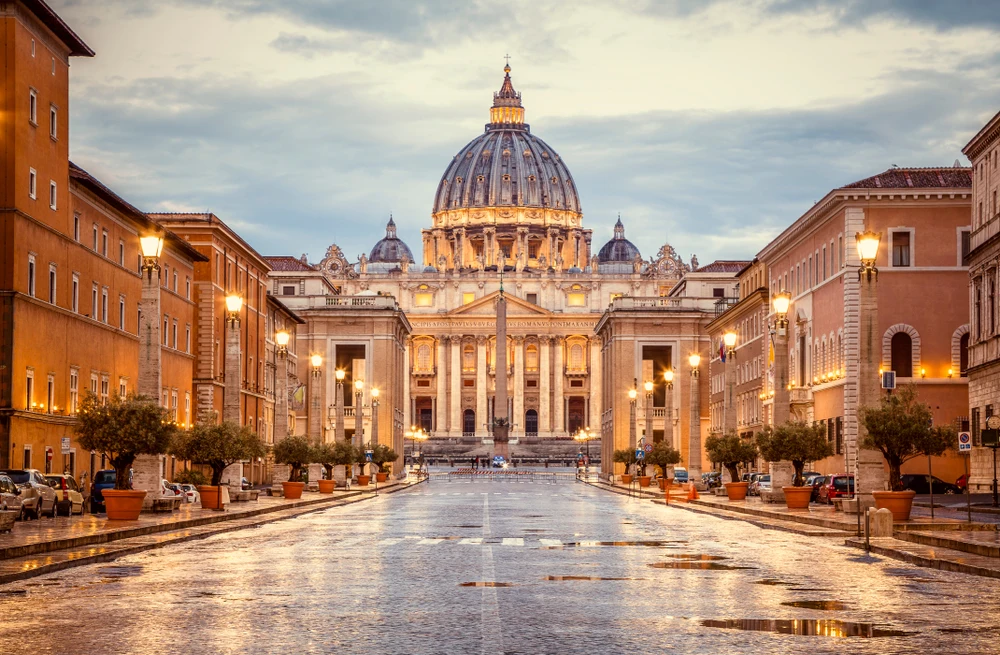
Few places in the world carry the same symbolic, artistic, and spiritual weight as St. Peter’s Basilica. Rising above the skyline of Rome with its monumental dome, the basilica is far more than a church. It is the result of nearly two thousand years of history, faith, architecture, political ambition, and artistic genius.
Millions of visitors enter St. Peter’s Basilica every year to admire its grandeur, but many people are unaware that the church visible today is actually the second basilica built on this sacred site. Long before the Renaissance masterpiece designed by figures such as Michelangelo and Gian Lorenzo Bernini, there was another enormous church commissioned by Emperor Constantine the Great in the 4th century.
The story of St. Peter’s Basilica is, in many ways, the story of Christianity itself: from persecution to imperial recognition, from medieval pilgrimage to Renaissance splendor, and from the heart of the Papal States to the center of the modern Catholic world.
Why was St. Peter’s Basilica built?
The origins of the basilica are deeply connected to the figure of Saint Peter, considered the first Pope according to Christian tradition.
After Peter’s martyrdom in Rome during the reign of Emperor Nero around 64 AD, he was believed to have been buried on the Vatican Hill, an area outside the ancient city walls. At the time, the location was close to the Circus of Nero, where many Christians were executed.
In the early centuries of Christianity, Peter’s tomb became an important place of devotion for believers. Pilgrims traveled to Rome specifically to pray near the apostle’s burial site, even when Christianity was still persecuted within the Roman Empire.
Everything changed after Constantine legalized Christianity through the Edict of Milan in 313 AD. Seeking to strengthen the connection between imperial power and the Christian faith, Constantine ordered the construction of a monumental basilica directly above what was believed to be Peter’s tomb.
The original Constantinian basilica became one of the most important pilgrimage destinations in the Christian world.
The first St. Peter’s Basilica under Constantine
The first basilica was completed during the 4th century and remained standing for more than one thousand years. Unlike the current Renaissance church, the original building followed the style of ancient Roman basilicas, with a long nave, colonnades, and a large atrium welcoming pilgrims.
Although it was architecturally simpler than today’s structure, it was immense for its time. The church quickly became the spiritual center of Western Christianity.
Over the centuries, popes enriched the basilica with mosaics, chapels, tombs, and precious decorations. Medieval pilgrims arriving in Rome often described St. Peter’s Basilica as one of the wonders of the Christian world.
At the same time, the church suffered repeated damage due to age, instability, and the natural deterioration of materials. By the 15th century, the structure was in poor condition. Parts of the building were reportedly close to collapse.
This led to one of the most ambitious architectural projects in history.
Why was the old basilica demolished?
The decision to demolish Constantine’s basilica was controversial even at the time.
Many people considered the ancient church untouchable because of its connection to Saint Peter and early Christianity. However, several popes believed that restoring the aging structure would not be enough.
In 1506, Pope Julius II officially launched the reconstruction of St. Peter’s Basilica. His vision was not simply to repair the church, but to create a monumental building that reflected the power and prestige of the Catholic Church during the Renaissance.
The original architect chosen for the project was Donato Bramante, who designed a massive centralized plan inspired by classical Roman architecture.
Construction would continue for more than a century, involving some of the greatest artists and architects of the Renaissance and Baroque periods.
The architects who shaped St. Peter’s Basilica
One of the reasons St. Peter’s Basilica fascinates historians and travelers today is that it represents the combined work of multiple generations of artistic geniuses.
After Bramante’s death, several architects modified the project, including Raphael and Antonio da Sangallo the Younger.
The most influential contribution came from Michelangelo, who became chief architect in 1546. He simplified the design and created the iconic dome that still dominates Rome’s skyline today.
Michelangelo did not live to see the basilica completed, but his vision transformed the project forever. The dome remains one of the greatest achievements of Renaissance engineering and continues to influence church architecture around the world.
Later, Carlo Maderno extended the nave and designed the monumental façade visible today, while Bernini created the breathtaking St. Peter’s Square with its famous colonnades.
The final basilica was consecrated in 1626.
The dome of St. Peter’s Basilica
One of the most recognizable features of St. Peter’s Basilica is its enormous dome.
Inspired partly by the Pantheon and the dome of Florence Cathedral, Michelangelo’s design achieved a remarkable balance between elegance and structural power. Standing inside the basilica and looking upward, visitors immediately understand why the dome is considered one of the masterpieces of Renaissance architecture.
Climbing to the top of the dome is still one of the most unforgettable experiences in Rome. From above, visitors can admire panoramic views over Vatican City, the Tiber River, and the historic center of Rome.
The dome also became a symbol of the city itself. For centuries, travelers approaching Rome described seeing the great cupola emerge above the urban landscape long before entering the city.
What can you see inside St. Peter’s Basilica?
The interior of St. Peter’s Basilica is astonishing not only because of its scale, but because nearly every corner contains works of extraordinary artistic and historical value.
Among the highlights is Michelangelo’s Pietà, sculpted when the artist was still in his twenties. The marble masterpiece depicts the Virgin Mary holding the body of Christ after the crucifixion and is widely considered one of the greatest sculptures ever created.
Another focal point is Bernini’s Baldachin, the massive bronze canopy rising above the papal altar and directly over the tomb of Saint Peter.
The basilica also contains countless chapels, mosaics, papal tombs, monuments, and inscriptions. Even visitors who are not religious often describe the experience as overwhelming because of the sheer scale and detail of the building.
An interesting fact many travelers do not realize is that most of the “paintings” inside the basilica are actually mosaics. This choice was made to preserve the artworks from humidity and candle smoke over the centuries.