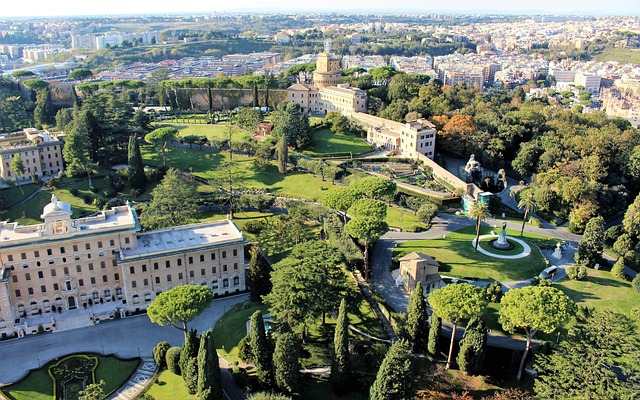
Hidden behind the walls of Vatican City lies one of the most unexpected and fascinating places in Rome: the Vatican Gardens. While millions of visitors flock each year to the Vatican Museums and St. Peter’s Basilica, only a smaller number venture into these peaceful gardens, where nature, art, and spirituality exist in perfect balance.
Exploring the Vatican Gardens is not simply about admiring flowers or fountains. It is an experience that reveals another side of the Vatican—more intimate, contemplative, and deeply symbolic. Walking along shaded paths, past historic chapels and panoramic viewpoints, you begin to understand why this area has long been reserved as a place of reflection for popes and clergy.
What are the Vatican Gardens?
The Vatican Gardens occupy roughly half of Vatican City’s territory. They are not a single garden in the traditional sense, but a collection of landscaped areas developed over centuries, blending Italian, French, and English garden styles. Their current layout reflects layers of history, from medieval orchards to Renaissance symmetry and later Romantic influences.
Originally used for practical purposes such as vineyards, vegetable plots, and medicinal herbs, the gardens gradually evolved into a refined space designed for contemplation and beauty. Over time, fountains, statues, and sacred monuments were added, transforming the area into an open-air spiritual and artistic journey.
A place shaped by history and faith
The history of the Vatican Gardens mirrors the history of the papacy itself. As popes settled permanently in the Vatican, the gardens became an extension of their private world—a place for walking, praying, and escaping the formal atmosphere of official duties.
Different popes left their mark on the gardens. Some focused on expanding green areas, others commissioned fountains or small shrines. This layered development is still visible today, where a Renaissance fountain may stand just steps away from a 20th-century Marian monument.
What makes the gardens unique is the way faith and landscape design intertwine. Every element, from the positioning of statues to the symbolism of water, carries meaning rooted in Christian tradition.
What to see inside the Vatican Gardens
Walking through the Vatican Gardens feels like moving through a living museum. The experience unfolds gradually, revealing highlights that surprise even seasoned Rome visitors.
Fountains and water features
Water plays a central role throughout the gardens. Elegant fountains, some centuries old, create a soothing soundtrack that accompanies your walk. These features are not only decorative but symbolic, representing purification, life, and spiritual renewal.
Among the most striking are Renaissance-era fountains adorned with coats of arms and classical motifs, alongside later designs that reflect changing artistic tastes.
The Lourdes Grotto
One of the most emotionally resonant spots in the gardens is the Grotto of Our Lady of Lourdes, a faithful reproduction of the famous shrine in France. This quiet corner is often used for private prayer and ceremonies, reinforcing the gardens’ role as a sacred space rather than a purely decorative one.
Even for visitors without religious beliefs, the atmosphere here is unmistakably serene and reflective.
Statues and monuments
Scattered throughout the gardens are statues of saints, the Virgin Mary, and other religious figures. These monuments come from different countries, reflecting the universal nature of the Catholic Church.
Each statue has a story—some were gifts from foreign communities, others commemorate significant moments in Church history. Together, they transform the gardens into a symbolic map of global Catholicism.
Panoramic views of Vatican City
The Vatican Gardens also offer some of the most unexpected viewpoints in Rome. From certain terraces, you can admire St. Peter’s Basilica from unusual angles, framed by greenery rather than crowds.
These viewpoints provide excellent photo opportunities and a rare chance to see iconic landmarks in a calmer, more personal setting.
Why the Vatican Gardens are different from other Roman gardens
Rome is famous for its gardens and parks, from Villa Borghese to the Orange Garden on the Aventine Hill. What sets the Vatican Gardens apart is their exclusive and protected nature.
Access is limited, and visits are structured, which preserves the peaceful atmosphere. There are no street performers, no traffic noise, and no casual passersby. Instead, the gardens maintain a sense of quiet dignity that feels increasingly rare in a busy city like Rome.
Unlike public parks, the Vatican Gardens were never intended for leisure in the modern sense. Their primary function has always been spiritual retreat, and that purpose still defines the experience today.