Galileo Galilei’s tomb
Another famous monument belongs to Galileo Galilei, one of the most important scientists in European history.
Galileo spent much of his life studying astronomy and physics and challenged some of the established ideas of his time. His discoveries played a fundamental role in the development of modern science.
His monumental tomb in Santa Croce was created decades after his death. The monument is particularly interesting because it reflects the way Galileo’s reputation changed over time, from a controversial scientific figure to a celebrated symbol of human knowledge.
Machiavelli’s tomb
Santa Croce is also home to the monument dedicated to Niccolò Machiavelli, the Florentine political thinker and author of The Prince.
Machiavelli’s work has influenced political thought for centuries. His connection with Florence is particularly strong, making Santa Croce an appropriate place for his memorial.
The monument is another reminder that the basilica is not simply associated with artists. Literature, politics, science and philosophy all have a place within its walls.
Dante’s memorial
Santa Croce also contains an imposing monument dedicated to Dante Alighieri, one of Italy’s greatest poets.
There is an important detail to remember: Dante is not actually buried in Santa Croce. His tomb is in Ravenna, where he died in exile.
The monument in Florence is therefore a memorial rather than a burial place. Its presence reflects the deep connection between Dante and his native city, even though Florence was also responsible for his exile.
For visitors interested in Italian literature, this is one of the most meaningful monuments in the basilica.
What to see inside Santa Croce
The famous tombs are an important part of the experience, but they are only the beginning.
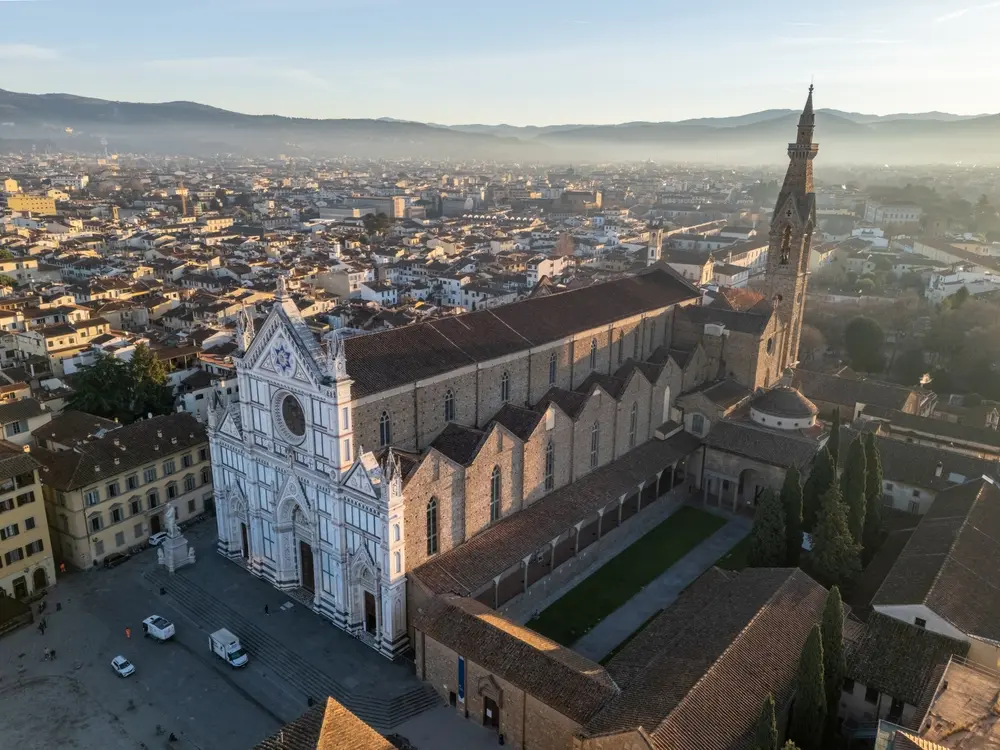
The interior of Santa Croce Basilica is an impressive example of Florentine Gothic architecture. Its vast nave, pointed arches and monumental proportions create a very different atmosphere from the city’s Renaissance palaces.
As you explore the church, pay attention to the chapels along the sides. Several contain important fresco cycles connected with Giotto and his school.
Giotto played a fundamental role in the development of Western painting. His figures appear more natural and expressive than many earlier medieval representations, and his work helped establish a new visual language that would later develop during the Renaissance.
The Bardi and Peruzzi chapels are particularly important for understanding his influence.
You can also admire works connected with Donatello, another giant of Florentine art. His sculptures demonstrate the extraordinary transformation taking place in Florence during the 15th century.
Rather than simply searching for the most famous tombs, take your time and look around. The combination of medieval frescoes, Gothic architecture, Renaissance sculpture and later monuments is what makes Santa Croce so special.
The Pazzi Chapel
One of the highlights of the Santa Croce complex is the Pazzi Chapel, a masterpiece of Renaissance architecture traditionally associated with Filippo Brunelleschi.
Located in the first cloister, the chapel offers a striking contrast with the Gothic interior of the basilica.
Where Gothic architecture emphasizes verticality and dramatic spaces, the Pazzi Chapel is based on proportion, symmetry and geometric harmony. Its clean architectural lines demonstrate the Renaissance fascination with mathematical order and classical principles.
The chapel was commissioned by the Pazzi family and served as a chapter house for the Franciscan community as well as a family chapel.
Even if you are not an architecture enthusiast, it is worth stepping inside. The peaceful atmosphere and carefully balanced design make it one of the most memorable spaces in the entire Santa Croce complex.
Why is Santa Croce called the Pantheon of Italy?
The nickname “Pantheon of Italy” comes from the extraordinary number of important Italians commemorated within the basilica.
During the centuries following the Renaissance, Santa Croce increasingly became associated with the celebration of great Italian personalities. The church became a symbolic place where the achievements of artists, writers, scientists and thinkers could be remembered.
This tradition became particularly powerful in the 19th century, when the idea of Italian national identity was developing.
The monuments inside Santa Croce therefore have a meaning that goes beyond their artistic value. Together, they create a kind of visual history of Italian culture.
You can move from Michelangelo to Galileo, from Machiavelli to Foscolo, and see how different generations interpreted the legacy of these figures.
How long does it take to visit Santa Croce?
If you only want to see the main attractions, allow at least one hour for your visit.
However, if you want to appreciate the frescoes, chapels, tombs, cloisters and Pazzi Chapel without rushing, it is better to allow around 90 minutes or more.
Santa Croce rewards visitors who take their time. Some of its most interesting details are easy to miss if you simply walk through looking for the famous tombs.
A good visit should combine the major highlights with a little time to simply observe the architecture and decoration around you.
Is Santa Croce worth visiting in Florence?
If you are wondering whether Santa Croce is worth visiting in Florence, it absolutely is.
The basilica offers something different from Florence’s other major attractions. The Duomo is an extraordinary symbol of the city, while the Uffizi is famous for its remarkable collection of Renaissance masterpieces. Santa Croce, instead, brings together art, architecture, religion, literature, science and Italian history in one place.
It also offers a fascinating way to understand Florence itself.
The city was not only the birthplace of artistic masterpieces. It was also home to thinkers, scientists, writers, architects and political figures whose ideas had an impact far beyond Tuscany.
Inside Santa Croce, all these stories come together.
Discover Santa Croce and Florence with Inside Out Italy
Santa Croce is one of those places that becomes even more fascinating when you know the stories behind what you are seeing. The tombs, frescoes and architectural details are not isolated works of art: they are part of the much larger story of Florence and Italy.
If you want to discover Florence beyond its most famous landmarks, book a Florence tour with Inside Out Italyand explore the city’s history, art and hidden stories with a deeper perspective. From Santa Croce to the historic centre, a guided tour can help you connect the places you visit with the people and events that made Florence one of the world’s great cultural capitals.