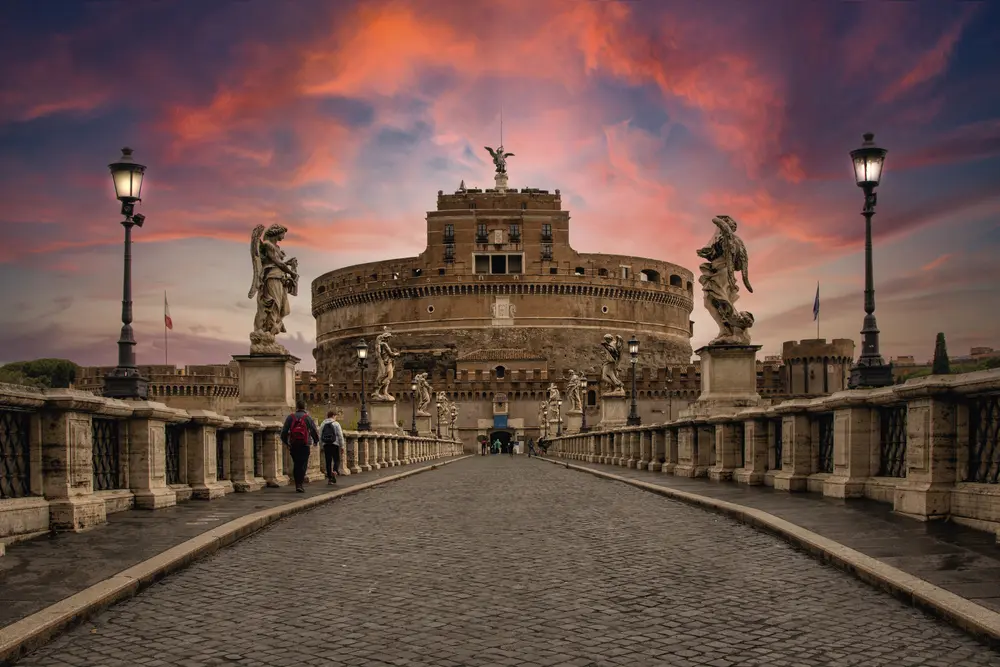
The Secret Passage to the Vatican
One of the most intriguing features of Castel Sant’Angelo is the Passetto di Borgo.
This elevated fortified corridor connects the castle directly to the Vatican. Built in the thirteenth century, the passage allowed popes to escape from danger and seek refuge inside the fortress whenever Rome became politically unstable.
The corridor became famous during the Sack of Rome in 1527, one of the darkest moments in the city’s history.
As imperial troops invaded Rome, Pope Clement VII fled through the Passetto di Borgo while Swiss Guards defended the Vatican. He successfully reached Castel Sant’Angelo, where he remained sheltered for several months.
The existence of this hidden escape route highlights the castle’s importance beyond military defense. It was not simply a fortress; it was also a lifeline for the papacy.
A Refuge for Popes
Over time, Castel Sant’Angelo became closely linked with the popes.
Many pontiffs transformed parts of the fortress into elegant private apartments decorated with Renaissance frescoes and luxurious furnishings.
Walking through these rooms today creates a fascinating contrast. Visitors move from dark military corridors and prison cells into richly decorated chambers that once hosted some of the most powerful religious figures in Europe.
These papal apartments reveal another layer of the monument’s identity. Castel Sant’Angelo was both a place of protection and a symbol of authority.
Its architecture reflects the constant balance between security and prestige that characterized the papacy during turbulent periods of history.
The Prison Within the Walls
Not all visitors to Castel Sant’Angelo arrived voluntarily.
For centuries, the fortress also functioned as a prison. Some of Rome’s most famous prisoners were held within its walls, including political enemies, religious dissidents, and intellectuals.
Among the best-known inmates was the Italian sculptor and goldsmith Benvenuto Cellini, who famously managed to escape before being recaptured.
The prison cells offer a glimpse into a much darker chapter of the monument’s past. Narrow chambers, thick walls, and minimal light remind visitors that Castel Sant’Angelo was designed to keep people both out and in.
This combination of palace, fortress, and prison is part of what makes the site so compelling today.
What Can You See Inside Castel Sant’Angelo?
Visitors often wonder whether entering the castle is worth it. The answer is undoubtedly yes.
Unlike many monuments that focus on a single historical period, Castel Sant’Angelo offers an immersive journey through nearly two millennia of Roman history.
Inside, visitors can explore:
- Ancient Roman architectural remains from Hadrian’s original mausoleum
- Medieval fortifications and defensive structures
- Renaissance papal apartments
- Historical prisons and military spaces
- Collections of weapons, artworks, and historical artifacts
- Panoramic terraces overlooking Rome
Each level reveals a different chapter in the building’s evolution.
As a result, visiting Castel Sant’Angelo feels less like touring a museum and more like moving through a living timeline of the city itself.
The Best View in Rome?
Rome is filled with spectacular viewpoints, but many travelers consider Castel Sant’Angelo one of the very best.
The terrace at the top offers a breathtaking panorama of the Eternal City.
From here, visitors can admire:
- St. Peter’s Basilica
- The Vatican
- The Tiber River
- Ponte Sant’Angelo
- The historic center of Rome
- The surrounding rooftops and domes
At sunset, the view becomes particularly memorable as the golden light illuminates Rome’s monuments.
For photographers, history enthusiasts, and first-time visitors alike, the terrace alone is worth the visit.
Few places combine historical significance and scenic beauty as effectively as Castel Sant’Angelo.
Why Castel Sant’Angelo Remains One of Rome’s Most Fascinating Landmarks
What makes Castel Sant’Angelo different from other attractions in Rome is its remarkable ability to tell multiple stories at once.
It is simultaneously a Roman mausoleum, a medieval fortress, a papal residence, a prison, and a museum.
Very few monuments in the world have adapted to so many different roles while remaining continuously relevant for nearly two thousand years.
Every corridor, staircase, and terrace reveals a new chapter of Rome’s history. The building reflects the city’s resilience, transformation, and enduring significance across centuries.
For anyone seeking a deeper understanding of Rome beyond the Colosseum and the Vatican Museums, Castel Sant’Angelo offers an unforgettable experience.
Explore Castel Sant’Angelo and Rome with Inside Out Italy
A visit to Castel Sant’Angelo becomes even more meaningful when experienced with expert guidance that brings its stories, legends, and hidden details to life.
Whether it is your first time in Rome or a return visit to the Eternal City, exploring the city’s most iconic landmarks with knowledgeable local guides can completely transform the experience.
Book a Rome tour with Inside Out Italy and discover the history, secrets, and unforgettable places that make Rome one of the world’s most extraordinary destinations.