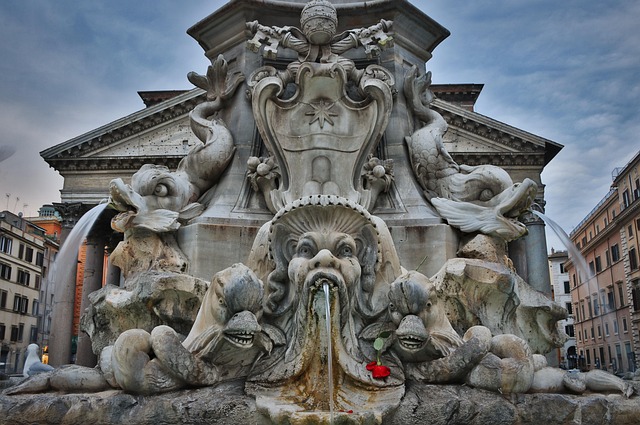
Rome is a city where water tells stories. Flowing from ancient aqueducts, cascading over marble sculptures, and gathering in sunlit piazzas, the fountains of Rome are far more than decorative landmarks. They are living monuments that reflect the city’s engineering genius, religious symbolism, political power, and artistic brilliance across more than two millennia. With over 2,000 fountains scattered throughout the Eternal City—ranging from monumental masterpieces to humble drinking fountains known as nasoni—Rome offers an open-air museum where water becomes art.
Ancient Origins: The Legacy of Roman Aqueducts
Long before the Baroque splendor that visitors admire today, Rome’s relationship with fountains began with necessity. In ancient times, public fountains served as essential water sources supplied by an extraordinary network of aqueducts. The Romans engineered these systems to transport fresh spring water from distant hills into the city, ensuring a constant flow for baths, households, and public spaces.
These early fountains were functional rather than ornamental, but they established a tradition: water in Rome would always be public, accessible, and abundant. Even after the fall of the Western Roman Empire, when many aqueducts fell into disrepair, the memory of Rome as a city of water endured.
The Baroque Transformation: When Fountains Became Spectacle
The true golden age of Roman fountains arrived during the Renaissance and Baroque periods, particularly in the 16th and 17th centuries. Popes and powerful families commissioned monumental fountains to celebrate the restoration of aqueducts and to assert their influence over the city’s urban landscape. Artists transformed water into theater, combining sculpture, architecture, and hydraulics to create dynamic compositions full of movement and symbolism.
Trevi Fountain: Rome’s Most Famous Wish
No fountain embodies Rome’s grandeur more than the Trevi Fountain, completed in 1762 and designed by Nicola Salvi. Dominating the façade of Palazzo Poli, the fountain depicts Oceanus emerging from a triumphal arch, flanked by allegorical figures representing Abundance and Health. Water crashes over rugged rocks into a vast basin, creating a dramatic scene that seems almost cinematic.
The fountain is also surrounded by legend. Tossing a coin over your shoulder into the water is said to guarantee a return to Rome. Every day, thousands of visitors participate in this ritual, transforming a Baroque masterpiece into a global symbol of hope and nostalgia. The coins collected are donated to charitable causes, giving the tradition a modern humanitarian dimension.
Fountain of the Four Rivers: Bernini’s Masterpiece
In the heart of Piazza Navona stands Gian Lorenzo Bernini’s Fountain of the Four Rivers, unveiled in 1651. This sculptural marvel represents the four great rivers of the continents known at the time: the Danube (Europe), Nile (Africa), Ganges (Asia), and Rio de la Plata (Americas). Each figure is carved with distinct gestures and attributes, symbolizing geography, culture, and political power.
An ancient Egyptian obelisk rises from the center, blending Roman imperial heritage with Christian symbolism. The composition appears almost gravity-defying, as if the massive stone monument floats above the rugged base. Bernini’s genius lies in this illusion of movement and tension, turning stone and water into a dramatic narrative about the reach of the Catholic Church and the universality of Rome.
The Spanish Steps Fountain: Barcaccia
At the foot of the Spanish Steps sits the charming Fontana della Barcaccia, designed by Pietro Bernini and his son Gian Lorenzo. Unlike the towering fountains of the Baroque era, this piece is low and intimate, shaped like a half-sunken boat. According to legend, it commemorates a flood of the Tiber River that carried a boat into the square.
Water gently spills from the vessel’s sides, creating a tranquil atmosphere amid one of Rome’s busiest areas. The Barcaccia illustrates how Roman fountains can be playful and poetic, not just monumental.