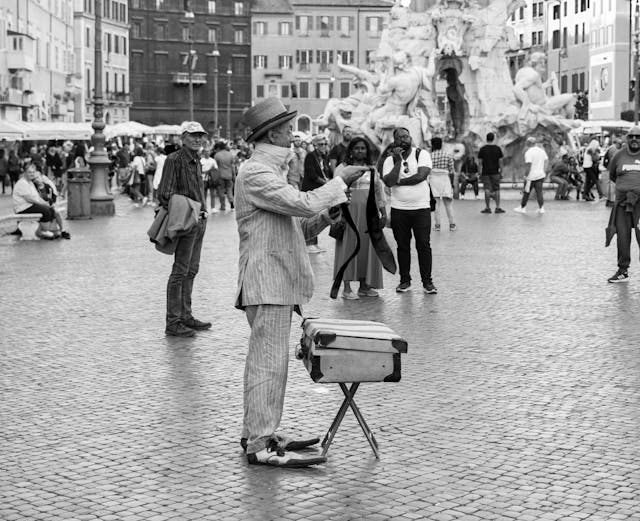
Why Piazza Navona is so famous
Piazza Navona’s fame is not based on a single element, but on the way multiple layers come together. It is famous for its Baroque art, for its unusual shape, and for its constant energy. Unlike more monumental spaces, Piazza Navona feels approachable. Artists sketch portraits, musicians perform under the open sky, and cafés invite visitors to pause and observe the flow of life.
Another reason for its popularity is its central location. Just steps away from the Pantheon and within walking distance of Campo de’ Fiori and Piazza Venezia, Piazza Navona naturally becomes part of any exploration of Rome’s historic center.
Piazza Navona at Christmas
During the Christmas season, Piazza Navona takes on a different personality. For generations, Romans have associated the square with the holidays, thanks to its traditional Christmas market. Wooden stalls line the square, selling decorations, sweets, toys, and seasonal treats. The atmosphere is lively, colorful, and unmistakably festive.
Children are especially drawn to the market, where the figure of the Befana, the friendly old witch of Italian folklore who brings gifts on Epiphany, appears in countless forms. Lights reflect off the fountains, street performers add music and laughter, and the Baroque architecture becomes an even more dramatic backdrop under the winter sky.
While the market has evolved over time, the connection between Piazza Navona and Christmas remains strong.
What to see around Piazza Navona
One of the pleasures of Piazza Navona is that it serves as a perfect starting point for exploring the surrounding area. A short walk leads to the Pantheon, one of the best-preserved ancient buildings in the world. Nearby streets reveal hidden churches, small art galleries, and historic palaces that often go unnoticed by hurried visitors.
The square itself is best experienced at different times of day. In the early morning, it feels calm and almost intimate. In the afternoon, it fills with life and movement. In the evening, the lights and reflections create a more romantic and theatrical atmosphere.
Practical tips for visiting Piazza Navona
Piazza Navona is always open and free to access, making it an easy stop at any point in your itinerary. Comfortable shoes are essential, as the historic center is best explored on foot. If you plan to sit at a café, keep in mind that prices in the square are higher than in nearby side streets, but the view and atmosphere are part of the experience.
For photography, early morning or late evening offers the best light and fewer crowds.
Experiencing Piazza Navona as part of Rome
Piazza Navona is more than a highlight on a checklist. It is a place that reflects Rome’s ability to layer history without losing its soul. Ancient foundations support Baroque masterpieces, which in turn frame modern life and age-old traditions like the Christmas market.
Whether you are drawn by art, history, or the warmth of the holiday season, Piazza Navona offers a moment where Rome feels both grand and familiar. Standing in the center of the square, surrounded by fountains, churches, and the sound of voices, it becomes clear why this place continues to enchant visitors from all over the world.
Experience Piazza Navona with a guided tour of Rome
To truly appreciate the history, art, and hidden details of Piazza Navona and the surrounding historic center, the best choice is to explore Rome with expert guidance. A guided tour of Rome with Inside Out Italy allows you to go beyond the surface, connecting Piazza Navona to nearby masterpieces, stories, and traditions that bring the city to life.
If you want to experience Rome through authentic insights, carefully curated itineraries, and local expertise, this is the perfect moment to book your Rome tour and discover the city from a deeper, more meaningful perspective.