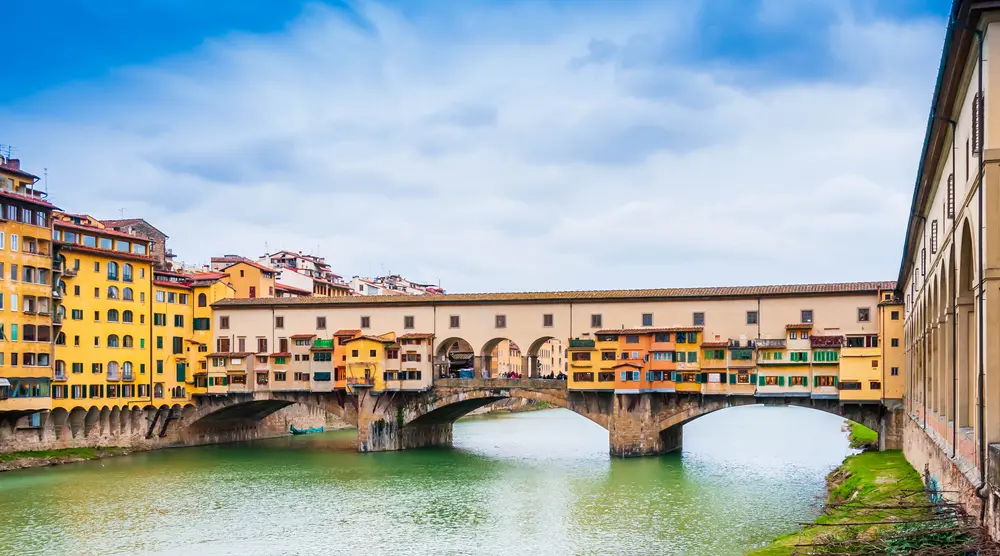
Ponte Vecchio is one of those rare places where history, architecture, and everyday life blend so seamlessly that it feels almost unchanged by time. Spanning the Arno River in the heart of Florence, this iconic bridge is far more than a crossing point—it is a living monument that has witnessed centuries of trade, politics, art, and human stories.
Today, visitors come for its postcard-perfect views and glittering jewelry shops, but the story of Ponte Vecchio is much deeper. To truly understand it, you need to step back into medieval Florence, when bridges were not just pathways, but essential economic lifelines.
A Bridge Built on Ancient Foundations
The origins of Ponte Vecchio date back to Roman times, when the first wooden structure likely connected the two sides of the Arno River. However, the bridge we see today was rebuilt in stone after repeated floods destroyed earlier versions.
By the 14th century, Florence had become a powerful commercial center in Europe, and the bridge evolved into a strategic marketplace. But unlike modern commercial streets, Ponte Vecchio developed a very specific identity: it became home to butchers, tanners, and fishmongers.
These trades were chosen for practical reasons. They needed constant access to water, and the bridge provided a convenient location for disposing of waste directly into the river. While this may sound unappealing today, in medieval Florence it was simply efficient urban planning.
However, this early version of Ponte Vecchio was far from the elegant landmark we know today.
The Renaissance Transformation: A Royal Decision
The most important turning point in the history of Ponte Vecchio came in the 16th century under the rule of the Medici family, one of the most influential dynasties in Italian history.
When the Medici began expanding their influence across Florence, they wanted a more dignified and secure connection between their residences and political offices. This led to the creation of the famous Vasari Corridor, an elevated passageway designed by Giorgio Vasari.
The corridor allowed the Medici to walk above the city, unseen and protected, connecting the Palazzo Vecchio with the Palazzo Pitti.
But there was a problem: the original shops on the bridge were considered too “low-class” for the Medici’s vision of Florence.
So in a dramatic urban transformation, the butchers and fishmongers were evicted and replaced by goldsmiths and jewelers—trades that were cleaner, more prestigious, and aligned with Renaissance ideals of beauty and refinement.
This decision forever changed the identity of Ponte Vecchio, turning it into one of the earliest examples of a luxury shopping street in the world.
Why Are There Shops on Ponte Vecchio?
One of the most common questions travelers ask about Ponte Vecchio is why it has shops at all, especially when most medieval bridges in Europe are purely functional.
The answer lies in Florence’s economic structure during the Middle Ages. The city was densely populated and commercially vibrant, so space was extremely valuable. Building shops on bridges allowed merchants to operate in one of the most trafficked areas of the city.
Over time, this practical decision became tradition, and tradition became identity.
Even today, the bridge maintains this unique configuration, with small, tightly packed storefronts lining both sides of the walkway. The result is a narrow, atmospheric corridor where visitors can browse jewelry while looking out over the flowing Arno River.
The Famous Goldsmiths of Ponte Vecchio
The modern identity of Ponte Vecchio is deeply tied to its goldsmiths and jewelry artisans. These shops are not just retail spaces; many are family-run workshops that have passed down techniques for generations.
Walking across the bridge today, you’ll notice that nearly every storefront displays gold, silver, and precious gemstones. Unlike mass-produced jewelry found elsewhere, many pieces here are crafted using traditional methods that reflect Florence’s artistic heritage.
This long-standing tradition has made Ponte Vecchio synonymous with luxury, craftsmanship, and exclusivity. It is also one of the few places in Florence where artisanal trade has remained continuously active for centuries.
Surviving War: The Only Bridge Spared in WWII
Perhaps one of the most fascinating facts about Ponte Vecchio is its survival during World War II.
When German forces retreated from Florence in 1944, most of the city’s bridges were destroyed to slow the Allied advance. However, Ponte Vecchio was spared. Instead of demolishing it, the retreating troops blocked access by destroying the buildings at either end of the bridge.
Why was it saved? The exact reason is still debated. Some believe it was due to its historical value, while others suggest it was simply too structurally complex to destroy quickly.
Regardless, its survival makes it the only medieval bridge in Florence that still retains its original form.