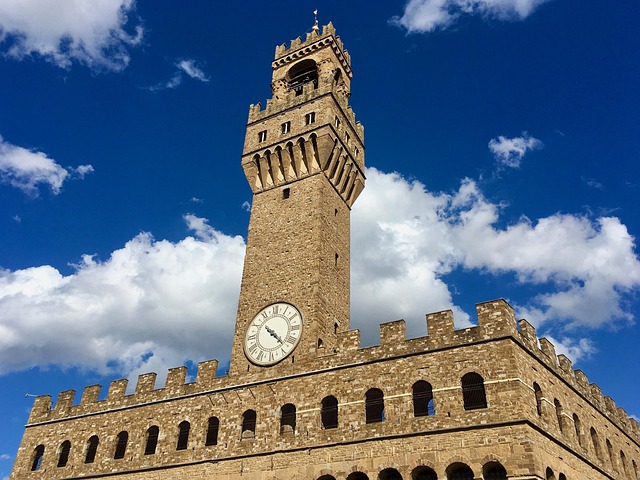
Standing proudly over Piazza della Signoria, Palazzo Vecchio is far more than a symbol of Florence’s skyline. It is a living chronicle of political power, artistic ambition, and civic identity, layered across centuries of Florentine history. From its imposing medieval architecture to its richly decorated halls, the palace offers a journey through the ambitions of the Republic of Florence and the rise of the Medici dynasty.
Exploring Palazzo Vecchio means stepping inside a building that has never stopped serving the city. Unlike many historic palaces turned solely into museums, Palazzo Vecchio still functions as Florence’s town hall, creating a fascinating dialogue between past and present. Each room tells a story—of government assemblies, artistic rivalries, secret passages, and carefully constructed symbolism.
A Brief History of Palazzo Vecchio
Palazzo Vecchio was built between 1299 and 1314 as the seat of the Florentine Republic. Designed by Arnolfo di Cambio, the palace was originally known as the Palazzo dei Priori, home to the city’s governing magistrates. Its fortress-like appearance was intentional: thick stone walls, narrow windows, and the soaring Arnolfo Tower all conveyed authority and protection in a turbulent political era.
Over time, the building’s role evolved. When the Medici family rose to power in the 16th century, the palace became the ducal residence of Cosimo I de’ Medici. Although Cosimo later moved to Palazzo Pitti, Palazzo Vecchio retained its importance as the administrative heart of Florence. This continuous use explains why the palace feels so authentic—its spaces were shaped by real political needs, not just aesthetic ideals.
Architectural Features That Define the Palace
One of the most striking elements of Palazzo Vecchio is its asymmetrical design. The Arnolfo Tower rises over 90 meters and can be climbed for panoramic views of Florence, rewarding visitors with vistas that stretch from the Duomo to the Tuscan hills.
Inside, the palace reveals a different personality. Medieval austerity gives way to Renaissance grandeur, particularly in the rooms renovated under Cosimo I. Frescoes, gilded ceilings, and monumental sculptures transform the palace into a visual narrative of power and legitimacy.
The Courtyard of Michelozzo
Upon entering Palazzo Vecchio, visitors are welcomed into the Courtyard of Michelozzo. Redesigned in the mid-15th century, this elegant space contrasts with the building’s austere exterior. Slender columns, decorative stucco work, and a painted ceiling create an atmosphere of refinement and order.
The courtyard was later adorned with frescoes depicting cities of the Habsburg Empire, reflecting Florence’s diplomatic ambitions. At its center stands a small fountain with a statue of a putto holding a dolphin, a copy of the original by Andrea del Verrocchio. This space served as a ceremonial threshold, preparing visitors for the grandeur that lay beyond.
The Salone dei Cinquecento
The Salone dei Cinquecento is the most famous and imposing room inside Palazzo Vecchio. Built to host the Grand Council of 500 citizens, the hall embodies the ideals of civic participation that defined the Florentine Republic.
Later transformed under Cosimo I, the hall was expanded and lavishly redecorated by Giorgio Vasari. Massive frescoes celebrate Florentine military victories, while the richly coffered ceiling features allegorical scenes glorifying Medici rule. Sculptures by Michelangelo and Bandinelli further enhance the room’s dramatic impact.
One of the most intriguing aspects of the Salone dei Cinquecento is the enduring mystery surrounding Leonardo da Vinci’s lost fresco, the Battle of Anghiari. Scholars continue to debate whether remnants of Leonardo’s work still lie hidden behind Vasari’s paintings, adding an element of intrigue to the hall.
The Apartments of the Medici
Beyond the grand public spaces, Palazzo Vecchio reveals a more intimate side in the Apartments of the Medici. These rooms were designed for private use and are richly decorated with frescoes illustrating classical mythology, biblical stories, and allegorical themes.
Each room served a specific function, from audience chambers to private studies. The decoration was carefully planned to reflect Medici values: wisdom, divine favor, and legitimate authority. The interplay between art and politics is particularly evident here, as visual narratives reinforce the ruling family’s image.
The Hall of Maps
One of the most fascinating rooms in Palazzo Vecchio is the Hall of Maps. Created in the late 16th century, this room functioned as a cabinet of curiosities and a display of global knowledge. Its walls are covered with detailed geographic maps representing the known world at the time, painted on wooden panels.
At the center of the room stands a massive terrestrial globe, once among the largest in existence. Hidden doors disguised within the map panels hint at secret passages and concealed storage, reminding visitors that Palazzo Vecchio was as much a strategic stronghold as a cultural monument.