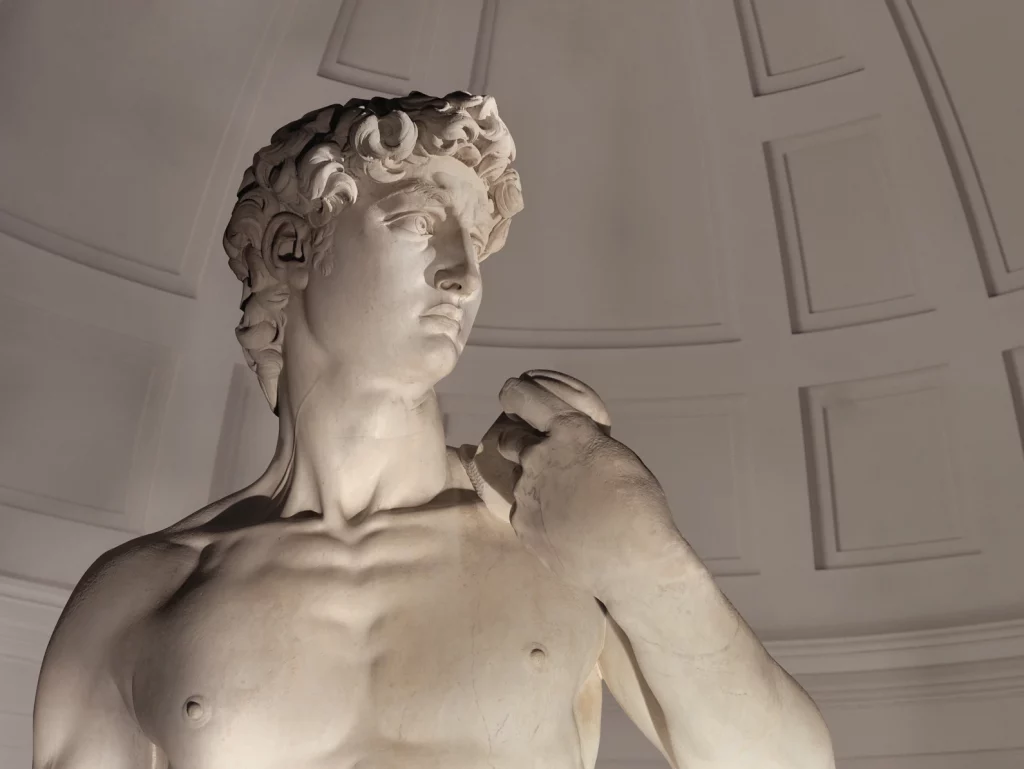
When one thinks of the Renaissance and its masterpieces, one statue inevitably rises above the rest: David, carved by Michelangelo Buonarroti between 1501 and 1504.
This monumental sculpture has fascinated art lovers, historians, and tourists for centuries — not only for its breathtaking beauty but also for the many hidden stories and technical secrets behind it.
In this article, we’ll explore some of the most interesting facts and curiosities about Michelangelo’s David, uncovering what makes this statue one of the greatest symbols of the Renaissance.
Michelangelo’s David: Size, Scale and the Genius Behind It
One of the first things you notice about Michelangelo’s David is its impressive height of 5.17 metres (17 ft) — taller than most people expect.
The statue was originally meant for the façade of the Florence Cathedral (Duomo), so Michelangelo had to adapt its proportions to be viewed from far below. Even more remarkably, the marble block he used had been abandoned by other sculptors who considered it “ruined.”
Turning an imperfect stone into a flawless masterpiece became one of Michelangelo’s greatest triumphs — a perfect example of Renaissance ingenuity.
The David Statue Meaning: Before the Battle, Not After
Most artists before Michelangelo depicted David after defeating Goliath, holding the giant’s head as a trophy. Michelangelo did the opposite: he sculpted David before the fight, filled with tension and quiet determination.
This subtle difference changes everything. His gaze, fixed and alert, shows intelligence over brute strength. The visible veins on his hands and neck capture the moment right before action — the psychological intensity of a hero in thought.
Through this choice, Michelangelo turned a biblical story into a timeless study of human courage and focus.
The Marble Block of David: From Rejected Stone to Masterpiece
The marble used for David came from Carrara, Italy’s most prestigious quarry, but the specific block had serious flaws. It was narrow, porous, and had already been roughly shaped by two previous artists who gave up on it.
When Michelangelo accepted the challenge in 1501, he saw potential where others saw failure. Over two years of relentless work, he transformed the flawed marble into a symbol of perfection — proving that genius can overcome limitation.
David’s Proportions and Michelangelo’s Optical Illusion
If you look carefully at David, his head and hands appear slightly larger than they should be. This was no mistake.
Because the statue was designed for high placement on a cathedral façade, Michelangelo exaggerated certain parts to compensate for perspective distortion. When viewed from below, everything looks perfectly balanced.
The large hands also underline David’s strength, while the prominent head symbolizes intellect — the mind and muscle united in a single form.
It’s one of the earliest and most brilliant examples of an artist using optical illusion to achieve harmony.
Where to See Michelangelo’s David Today
Originally unveiled in Piazza della Signoria in 1504, right in front of Florence’s Palazzo Vecchio, David quickly became a symbol of Florentine freedom and civic pride.
In 1873, to protect it from weather damage, the statue was moved to the Galleria dell’Accademia, where it still stands today under a skylit dome designed specifically for it.
A full-size replica now occupies the original outdoor location, reminding visitors of the statue’s enduring bond with the city of Florence.
If you want to see Michelangelo’s David in Florence, the Accademia Gallery is the only place to admire the original masterpiece.