Hidden within the walls of Vatican City, the
Sistine Chapel is one of the most iconic and awe-inspiring landmarks of Western art. Known globally for its breathtaking ceiling painted by Michelangelo, the Chapel is not just a masterpiece of the Renaissance but also a vital religious and cultural site. Each year, millions of visitors cross its threshold, eager to admire its stunning frescoes and uncover the stories behind its creation. In this article, we’ll explore the
artistic treasures, the
historical evolution, and the
spiritual importance of the Sistine Chapel, answering common questions such as “Who painted the Sistine Chapel ceiling?” and “What is the significance of the Last Judgment?”
Where is the Sistine Chapel and Why Is It Important?
The Sistine Chapel is located inside the Apostolic Palace, the official residence of the Pope, within
Vatican City. Its official name is
Cappella Sistina, named after
Pope Sixtus IV, who commissioned the restoration of the former Cappella Magna in 1477. While the Chapel today is best known for its Renaissance frescoes, it also plays a vital
role in Catholic tradition. It is the site of the
Papal Conclave, where cardinals gather to elect a new Pope, under Michelangelo’s towering image of divine judgment. But what draws most visitors is not just the Chapel’s religious function—it’s the incredible art that adorns every inch of its walls and ceiling.
A Brief History of the Sistine Chapel
The construction of the Sistine Chapel began under
Pope Sixtus IV and was completed between 1477 and 1480. The architecture was designed by
Baccio Pontelli, while
Giovanni de Dolci oversaw the construction. Its initial purpose was to serve as the pope’s private chapel, but over time, it evolved into a space for major papal ceremonies. The early decorations included frescoes by masters like
Sandro Botticelli,
Domenico Ghirlandaio,
Cosimo Rosselli, and
Pietro Perugino, who covered the side walls with scenes from the
Old and New Testament. But the real transformation came a few decades later, when a young sculptor was summoned to paint the ceiling—an artist who would change the course of art history forever.
Michelangelo and the Ceiling That Changed Everything
In 1508,
Michelangelo Buonarroti was reluctantly commissioned by
Pope Julius II to paint the ceiling of the Sistine Chapel. Though known primarily as a sculptor, Michelangelo accepted the challenge. What followed was four years (1508–1512) of intense labor, frustration, and ultimately, creative triumph. The result? A sweeping visual narrative of the
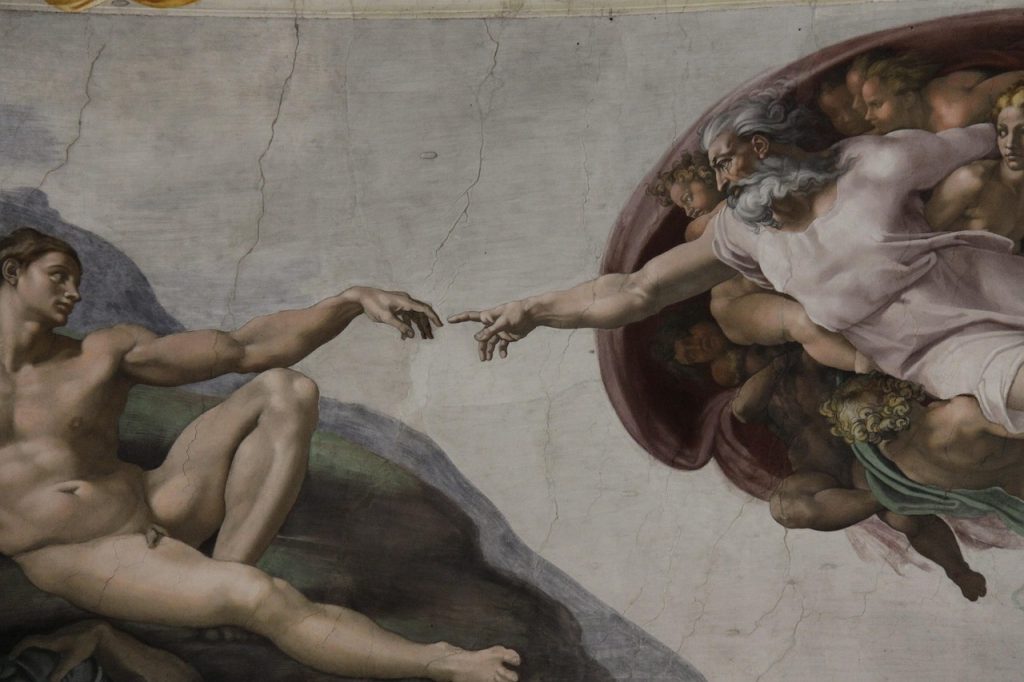
Book of Genesis, spanning over 500 square meters and featuring more than 300 figures. Among these, the most iconic is undoubtedly
The Creation of Adam, where God reaches out to touch the fingertip of a reclining Adam—a moment that has become one of the most reproduced images in the world. Michelangelo’s use of human anatomy, perspective, and symbolism revolutionized the very concept of ceiling painting. His figures possess a dynamic tension and emotional expressiveness that remains unmatched even today.
What’s Depicted on the Sistine Chapel Ceiling?
The central panels of the ceiling recount episodes from Genesis, including:
- The Separation of Light from Darkness
- The Creation of the Sun, Moon, and Plants
- The Creation of Adam and Eve
- The Expulsion from the Garden of Eden
- The Story of Noah
Surrounding these scenes are
Sibyls and Prophets,
ancestors of Christ, and intricate architectural elements—all painted to mimic real 3D structures through the technique of
trompe-l’œil. Michelangelo worked mostly alone, high atop scaffolding he designed himself, painting while lying on his back for hours at a time. He described the experience as torturous—but his sacrifice resulted in one of humanity’s greatest artistic achievements.