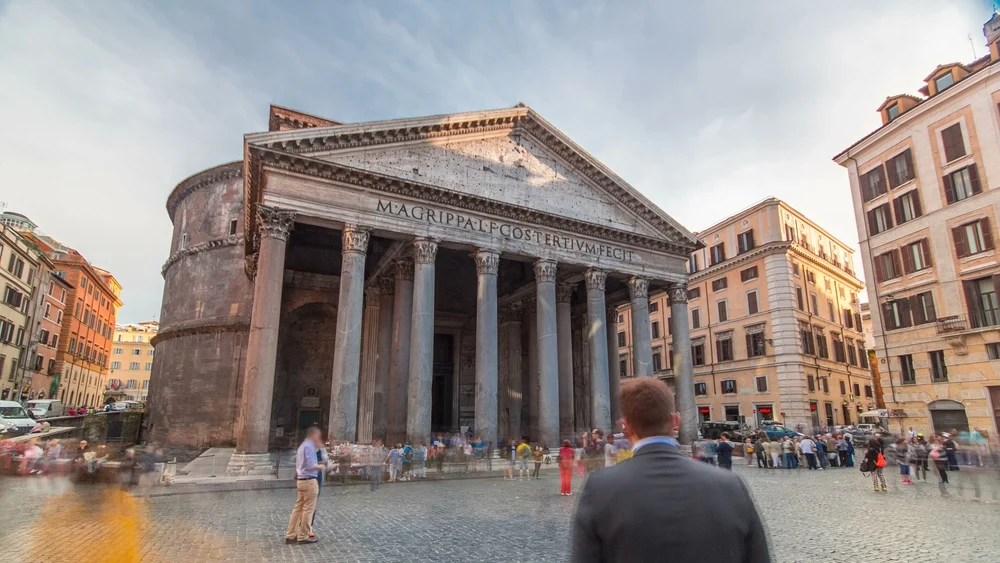
Few monuments in the world embody the grandeur, ingenuity, and endurance of ancient civilization quite like the Roman Pantheon. Standing at the heart of Rome, this architectural masterpiece has witnessed nearly two millennia of history, surviving the fall of the Roman Empire, the rise of Christianity, and the transformations of the modern city. Yet, despite its age, the Pantheon remains astonishingly intact—its presence as powerful today as it was in antiquity.
To understand the Pantheon is to explore not just a building, but a story of ambition, destruction, rebirth, and timeless brilliance.
The origins of the Pantheon: from Agrippa to Hadrian
The story of the Pantheon begins in 27 BC, during the reign of Emperor Augustus. It was Marcus Agrippa, Augustus’ trusted general and son-in-law, who commissioned the original structure. This first version of the Pantheon was part of a grand architectural program intended to glorify Rome and celebrate its expanding power.
However, the Pantheon we see today is not Agrippa’s original building. That structure was destroyed by fire in 80 AD, rebuilt by Emperor Domitian, and then struck again by lightning and burned down in 110 AD.
What stands today is the result of Emperor Hadrian’s vision. Around 126 AD, Hadrian ordered the complete reconstruction of the Pantheon. Interestingly, he chose to preserve Agrippa’s name on the façade, a decision that has puzzled historians for centuries. The inscription still reads:
“M·AGRIPPA·L·F·COS·TERTIVM·FECIT” (Marcus Agrippa, son of Lucius, made this building when consul for the third time)
This choice reflects a Roman tendency to honor legacy and continuity, even when creating something entirely new.
A temple to all gods: meaning behind the name
The name “Pantheon” derives from the Greek words pan (all) and theos (gods), meaning “temple of all gods.” While its exact religious function is still debated, it is widely believed that the Pantheon was dedicated to multiple deities, symbolizing the inclusiveness of Roman religion.
Unlike traditional Roman temples, which were usually rectangular and oriented in a specific direction, the Pantheon’s design is radically different. Its circular structure suggests a more universal, cosmic symbolism—an architectural representation of the heavens and divine order.
The architectural revolution of the dome
The most striking feature of the Pantheon is undoubtedly its dome, a feat of engineering that remains unmatched even today.
With a diameter of 43.3 meters (142 feet), the dome forms a perfect hemisphere. What makes it even more impressive is that it was constructed entirely from unreinforced Roman concrete, a material that the Romans mastered long before modern engineering.
The dome’s design is not just about scale, but also about precision and balance. As the structure rises, the materials become progressively lighter. At the base, heavy travertine and brick provide strength, while at the top, lighter pumice stone reduces weight—an ingenious solution that allowed the structure to stand for nearly 2,000 years.
At the center of the dome lies the oculus, a circular opening measuring about 9 meters in diameter. This is the Pantheon’s only source of natural light, and it creates a dramatic effect throughout the day as sunlight moves across the interior.
The oculus is more than a structural solution—it is deeply symbolic. It connects the interior space to the sky, reinforcing the idea of the Pantheon as a bridge between the earthly and the divine.
Inside the Pantheon: harmony and perfection
Stepping inside the Pantheon is a profoundly immersive experience. The interior space is perfectly proportioned: the height of the dome is exactly equal to its diameter, creating a sphere that could fit perfectly within the structure.
This harmony of proportions reflects the Roman pursuit of order, balance, and mathematical perfection.
The walls are adorned with marble from across the empire—Egyptian granite, Greek marble, and other exotic materials that demonstrate the vast reach of Roman trade and influence. Niches around the interior once housed statues of gods, emperors, and important figures.
Today, the Pantheon also serves as a burial site. Among those interred here is Raphael, one of the greatest artists of the Renaissance, whose presence adds another layer of cultural significance to the monument.